














How to Perform the Nordic Hamstring Curl with Proper Form
- Begin by kneeling on a soft surface or exercise mat. Secure your ankles under a heavy, stable object like the base of a power rack, or have a training partner hold your heels firmly against the floor.
- Maintain a rigid posture from your knees to your head. Tighten your midsection, engage your glutes, and ensure your torso remains in a straight line.
- Slowly lower your chest toward the ground. Focus on using your hamstrings to resist gravity, controlling the descent as much as possible.
- Once the tension becomes too great to hold, extend your arms to catch yourself. Use a slight push-up motion to absorb the impact and lower your chest fully to the floor.
- Push off the ground with your hands just enough to get started, then immediately engage your hamstrings and glutes to pull your torso back up to the vertical starting position.
Pro Tips for Maximum Safety and Efficiency
- Prioritize knee comfort. Use a thick yoga mat, a dedicated knee pad, or a folded towel to prevent discomfort during the kneeling phase.
- Focus on total-body tension. By keeping your glutes and lower back engaged, you ensure the hamstrings are doing the bulk of the work rather than allowing your hips to hinge prematurely.
- Incorporate “isometrics” if you struggle with the full range. If you can’t yet control the entire descent, try holding the most difficult angle for about five seconds before finishing the rep.
- Lead with your hips. If you find your back arching or your butt sticking out, visualize moving your hips toward the floor rather than just your shoulders.
- Try this at home. If you lack gym equipment, you can perform this move by anchoring your feet under a heavy couch or a sturdy bed frame.
A Critical Review of the Nordic Hamstring Curl
In the world of bodyweight training, the Nordic hamstring curl stands out as one of the few effective ways to challenge the posterior chain without heavy iron. Because the hamstrings are typically best trained with machines (like leg curls) or heavy free weights (like deadlifts), finding a high-tension bodyweight alternative is rare.
However, despite its popularity, this exercise has several limitations that prevent it from being a primary muscle-building staple for most athletes. First, the resistance curve is highly inconsistent. The movement feels relatively easy at the top but becomes exponentially harder as you approach the floor. This means your muscles are only reaching maximum stimulation during a small window of the movement.
Second, tracking progress can be difficult. Since most people require some level of assistance from their arms, it is hard to tell if you are getting stronger or simply using your upper body more to “cheat” the rep. Finally, “progressive overload”—the key to muscle growth—is tricky. While you can wear a weighted vest, it often interferes with the mechanics of the move and makes the “catch” at the bottom more dangerous.
The Nordic curl is an excellent tool for home workouts or as a finishing move, but it is generally less efficient than dedicated gym equipment for pure hypertrophy. If you choose to include them, aim for high-effort sets of as many reps as possible. Once you can comfortably perform 12 to 15 reps with perfect control and no arm assistance, you will likely see better results by moving toward weighted variations or machine-based exercises.
Effective Alternatives for Hamstring Development
- Seated Leg Curl: Widely considered the gold standard for hamstring isolation, this machine provides constant tension and allows for precise weight increments.
- Lying Leg Curl: A classic alternative to the seated version that targets the hamstrings through a similar range of motion with excellent stability.
- Barbell Romanian Deadlift (RDL): Unlike the Nordic curl which focuses on knee flexion, the RDL emphasizes hip extension, making it the premier choice for building overall posterior chain power.
- Dumbbell Romanian Deadlift: A versatile version of the RDL that is perfect for home gyms or focusing on unilateral balance.
- Barbell Good Morning: A powerful hip-hinge movement that shifts the load to the hamstrings and lower back, ideal for those who want to build strength without being limited by grip strength.
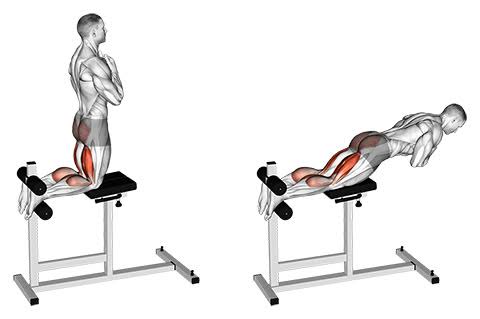
- Glute-Ham Raise (GHR): Performed on a specific GHD machine, this movement is similar to the Nordic curl but offers a more consistent resistance profile throughout the rep.
A Sample Training Routine Featuring the Nordic Curl
To see how this exercise fits into a balanced session, consider this full-body or lower-body focused circuit:
- Bodyweight Squats: 3 sets of 10–15 reps (1–2 min rest)
- Nordic Hamstring Curls: 3 sets of as many reps as possible (1–2 min rest)
- Push-ups: 3 sets of 10–15 reps (1–2 min rest)
- Inverted Bodyweight Rows: 3 sets of 10–15 reps (1–2 min rest)
Anatomy: Muscles Targeted During the Movement
The primary focus of the Nordic curl is the hamstring group, which consists of three distinct muscles: the biceps femoris (comprising a long and short head), the semitendinosus, and the semimembranosus. While the hamstrings do the majority of the heavy lifting, the glutes and erector spinae (lower back) act as stabilizers to keep your torso rigid throughout the exercise.
Expanding Your Hamstring Training
For a complete physique and injury prevention, it is vital to train the hamstrings using both knee flexion (like the Nordic curl) and hip extension (like the deadlift). Balancing these movements ensures that all heads of the hamstring are developed equally, improving both athletic performance and aesthetic symmetry.
Final Thoughts on the Nordic Hamstring Curl
The Nordic hamstring curl is a high-intensity bodyweight exercise that excels at building eccentric strength and resilience in the posterior chain. While it may have a steep learning curve and a finicky resistance profile, its ability to tax the hamstrings without heavy weights makes it a valuable tool for any fitness enthusiast. For the best results, use it as a supplement to heavy compound lifts, focusing on slow, controlled descents to maximize muscle fiber recruitment and safeguard your joints.