



















While many gym-goers default to pairing the back with the biceps or the chest with the triceps, training the back and triceps together is a highly effective strategy for building a powerful upper body. The logic is simple: these muscle groups perform completely different functions. Because back exercises don’t significantly involve the triceps, and vice versa, you can train both with maximum intensity in a single session without the fatigue from one exercise ruining your performance on the next.
Training with “fresh” muscles allows you to move heavier loads and complete more repetitions. Over time, this increased work capacity is the primary driver for muscle hypertrophy and strength. Furthermore, these two groups are essential for a balanced physique. A strong back provides the necessary stability for heavy squats and bench presses, while the triceps make up roughly two-thirds of your upper arm mass. Focusing on the triceps is actually the fastest way to build impressive arm size, while a well-developed back creates that sought-after V-taper.
Essential Training Highlights
- Because back and triceps exercises are non-overlapping, you can maintain high performance throughout the entire workout.
- Research suggests that performing 6 to 10 high-intensity sets per muscle group per session is the “sweet spot” for maximizing growth while managing recovery.
- Supersetting back and triceps movements can reduce your time in the gym by nearly 40% without sacrificing your results.
The Ultimate Back and Triceps Routine for Hypertrophy and Power
To build a thicker back and larger arms, you need a routine that prioritizes heavy compound movements and strategic isolation work. This program is designed to hit every major muscle in the back—including the lats, traps, and rhomboids—while ensuring all three heads of the triceps are fully stimulated.
The Science Behind This Training Split
Many programs fail because they include too much “junk volume.” Doing an excessive number of sets leads to diminishing returns and increased injury risk. Evidence indicates that doing more than 10 hard sets per muscle group in a single session provides very little extra benefit but significantly increases systemic fatigue. This specific routine uses 9 sets for the back and 6 for the triceps, placing you perfectly within the most effective range.
The back portion of the workout focuses on heavy compound lifting, which allows for consistent progressive overload. We then move to triceps isolation exercises that specifically target the long, lateral, and medial heads to ensure balanced arm development. This combination of heavy loading and targeted volume is the most reliable way to transform your physique.
Mastering the Best Back and Triceps Exercises
Choosing the right exercises is just as important as the split itself. Here is a breakdown of the movements that will provide the greatest return on your investment in the gym.
The Conventional Barbell Deadlift
The deadlift is the king of back exercises. It engages the entire posterior chain, specifically targeting the spinal erectors, traps, and rhomboids. Because you can move more weight with the deadlift than almost any other exercise, it is an unparalleled tool for building raw strength and overall mass. Since it is the most demanding movement, it should always be performed first when your energy levels are highest.
Execution: Stand with your feet hip-width apart and the bar over your midfoot. Bend down to grip the bar just outside your shins, flatten your back, and drive through your heels to stand up. Control the weight as you return it to the floor.
Expert Tip: Imagine “tucking” your shoulder blades into your back pockets before you pull. This engages your lats and creates a rigid torso, protecting your spine and allowing for a more powerful lift.
Wide-Grip Lat Pulldown
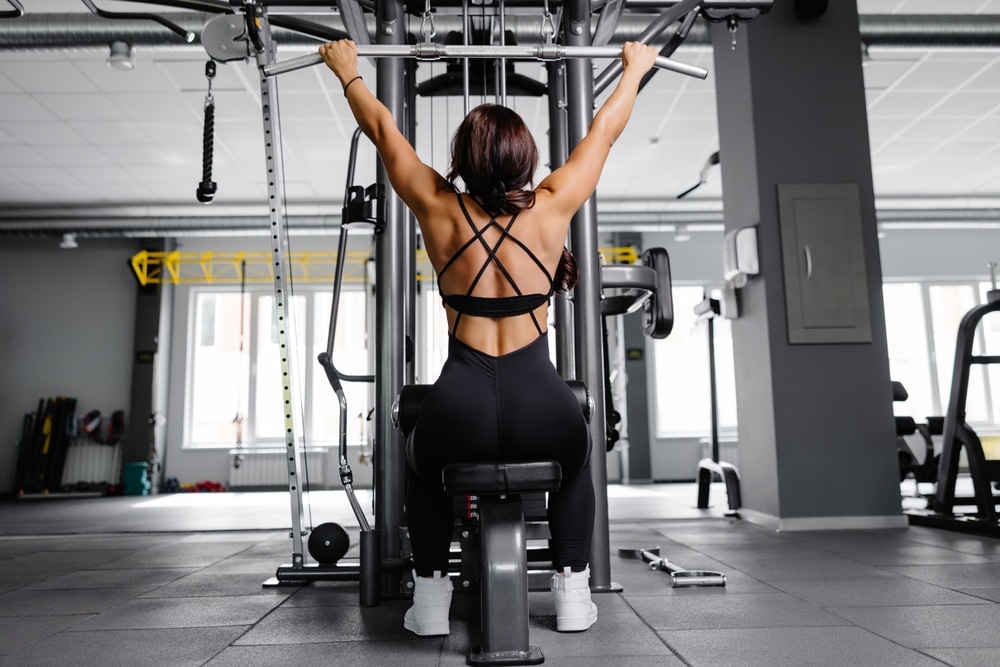
While the deadlift builds thickness and strength, the lat pulldown is essential for building back width. It specifically targets the latissimus dorsi. Performing this after deadlifts is also a smart recovery strategy, as it allows you to train your back intensely while giving your lower back and legs a break.
Execution: Sit at the machine with your thighs secured. Use a grip slightly wider than shoulder-width. Pull the bar toward your upper chest by driving your elbows down toward the floor, then slowly return to the starting position.
Expert Tip: Focus on pulling with your elbows rather than your hands. Thinking of your hands as mere “hooks” helps ensure the back does the work instead of the biceps.
Single-Arm Dumbbell Row
The single-arm row is a horizontal pulling movement that complements the vertical pull of the lat pulldown. By training each side independently, you can identify and fix strength imbalances. This movement is excellent for developing the mid-back and adding detail to the lats.
Execution: Place one hand and the same-side knee on a bench. With a flat back, pull a dumbbell from arm’s length up toward your hip, then lower it under control.
Expert Tip: Let the weight stretch your shoulder blade toward the floor at the bottom of each rep. This full range of motion recruits more muscle fibers and leads to better growth.
Seated Overhead Dumbbell Triceps Extension
To maximize arm size, you must target the “long head” of the triceps. The long head is the largest part of the muscle, and it is most effectively trained when the arms are overhead. This exercise puts the triceps in a deep stretch, which is a powerful stimulus for muscle gain.
Execution: Sit on a bench and hold one end of a dumbbell with both hands overhead. Lower the weight behind your head by bending only at the elbows, then press it back to the ceiling.
Expert Tip: Keep your upper arms tucked close to your ears and stationary. Shifting your elbows forward or outward reduces the tension on the triceps and increases the risk of hitting your head.
EZ-Bar Skullcrusher (Lying Triceps Extension)
The skullcrusher is a classic mass-builder that hits all three heads of the triceps. Unlike many cable movements, the skullcrusher allows for heavy loading, making it a staple for anyone looking to increase pressing strength.
Execution: Lie on a flat bench holding an EZ-bar over your chest. Bend your elbows to lower the bar toward your forehead (or slightly behind it), then extend your arms back to the start.
Expert Tip: Lowering the bar slightly behind your head rather than directly to your forehead keeps constant tension on the triceps and is often more comfortable for those with sensitive elbow joints.
Optimizing Efficiency with Back and Triceps Supersets
If you are short on time, this workout is a perfect candidate for supersetting. By alternating a back exercise with a triceps exercise, you can cut your total workout time by about 37% without losing effectiveness. Research confirms that as long as the muscles don’t overlap, supersets do not negatively impact strength gains.
However, there are rules to follow. Never superset the deadlift; it is too cardiovascularly demanding and requires your full focus for safety. For the rest of the workout, pair the lat pulldown with the overhead extension and the dumbbell row with the skullcrusher. This is logistically easy as you can stay in one area of the gym for each pair.
Adapting the Routine for a Dumbbell-Only Setup
If you train at home or in a limited facility, you can still get an incredible back and triceps workout using only dumbbells. Here is how to modify the routine:
- Dumbbell Deadlift: 3 sets of 8–10 reps. (If these feel awkward, substitute with Dumbbell Romanian Deadlifts).
- Single-Arm Dumbbell Row: 3 sets of 8–10 reps.
- Dumbbell Pullover: 3 sets of 8–10 reps. (This effectively replaces the lat pulldown for lat development).
- Overhead Dumbbell Extension: 3 sets of 8–10 reps.
- Dumbbell Skullcrusher: 3 sets of 8–10 reps.
How to Ensure Consistent Muscle Growth and Strength Gains
The most important factor in any workout is progressive overload. If you do the same weights and reps forever, your body has no reason to change. To ensure you are actually moving forward, you must train with sufficient intensity and track your progress.
Aim to finish every set about 1 to 2 repetitions shy of technical failure. This ensures the muscle is sufficiently challenged without causing excessive central nervous system fatigue. Use a “double progression” model: pick a rep range (e.g., 4–6 reps). Once you can perform 6 reps with a certain weight, increase the weight by 5 to 10 pounds in your next session. This constant cycle of increasing reps and then increasing weight is the engine of muscle growth.
Top Supplements for Muscle Recovery and Performance
Supplements are not a requirement for success, but they can certainly accelerate your results. If your diet and training are on point, these three options offer the most scientific backing:
- Protein Powder: Makes it easier to hit your daily protein requirements, which are essential for repairing the muscle tissue you break down during your back and triceps session.
- Creatine Monohydrate: The most researched supplement in fitness. It helps increase strength, power output, and muscle volume.
- Pre-Workout: A high-quality pre-workout can improve focus and reduce the perception of effort, allowing you to train harder for longer.
Summary: Maximize Your Upper Body Results
Training the back and triceps together is a smart, science-based way to organize your weekly routine. By pairing these non-competing muscle groups, you ensure that every set is performed with high intensity. Focus on heavy compound movements like deadlifts and rows to build back thickness, and prioritize overhead extensions to unlock maximum triceps growth. Whether you use straight sets or time-saving supersets, the keys to success remain the same: high effort, proper form, and consistent progressive overload. Stick to this framework, and you will see significant improvements in both your strength and your physique.