
















Step-by-Step Guide to the Seated Leg Curl
- Position yourself in the machine and adjust the settings so the padded lever rests comfortably against your Achilles tendons. The thigh restraint should be snug against your lower quads, ensuring your knees extend slightly past the edge of the seat.
- Move the backrest as far forward as possible while maintaining a secure, anchored position for your thighs. This forward positioning creates greater initial tension in the hamstrings.
- Grasp the side handles for stability and keep your back firmly against the pad. Contract your hamstrings to pull your heels down and toward the seat until you reach the machine’s full range of motion.
- Hold the peak contraction for a split second before slowly returning the weight to the starting position with full control.
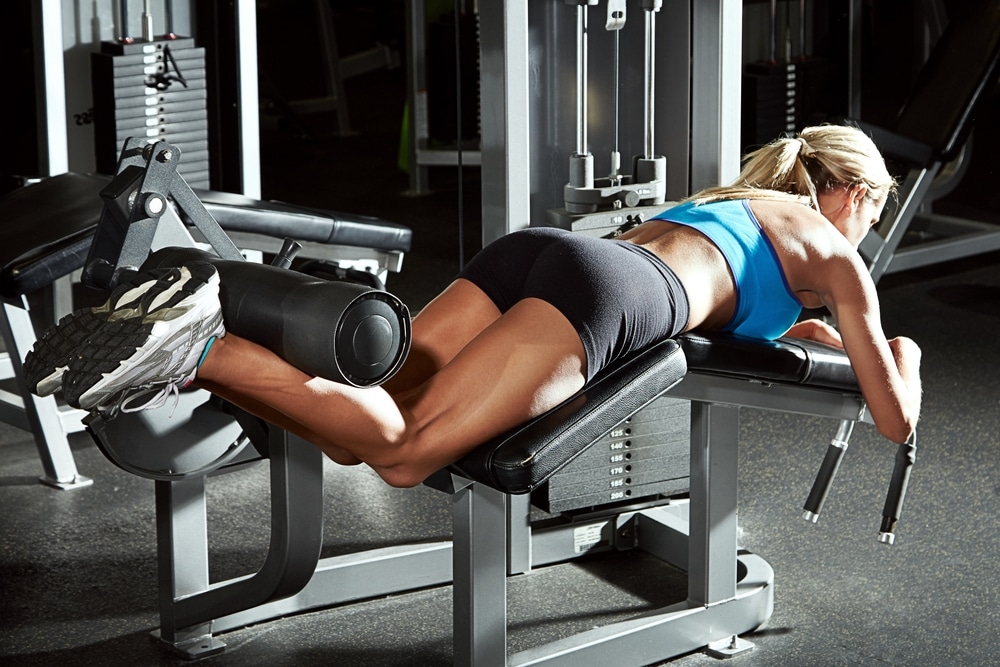
How to Execute the Lying Leg Curl Correctly
- Lie prone on the machine, aligning your knees with the pivot point. Adjust the roller pad so it sits just above your heels on the Achilles tendons.
- Hold the handles and curl your heels toward your glutes until your calves make contact with your hamstrings.
- Pause briefly at the top of the movement to emphasize the contraction, then lower the weight steadily back to the start.
The Lying Leg Curl with Hip Extension Technique
- Begin in the standard lying leg curl position with the pad resting on your Achilles tendons. You may find it more effective to set the pad slightly lower on the ankle than you would for a standard curl.
- Initiate the curl by bringing your heels toward your glutes until you reach full knee flexion.
- At the peak of the curl, squeeze your glutes intensely to lift your thighs a few inches off the bench.
- Hold the top position momentarily, then reverse the sequence: lower your thighs back to the pad first, then extend your legs to the starting position.
Pro Tips for Maximizing Hamstring Recruitment
- Optimize the Seated Setup: Set the thigh pad as low as possible to create significant pressure against your legs. You should feel your hamstrings engaging before the first rep begins. Additionally, keep the backrest upright; a more vertical torso tilts the pelvis forward, increasing the stretch on the hamstrings.
- Maximize Range of Motion: Use the highest setting for the heel pad during seated curls and the lowest setting for lying curls. This ensures the muscle is challenged through its longest possible range, which is critical for hypertrophy.
- The Power of Dorsiflexion: Keep your toes pulled back toward your shins throughout the set. This position lengthens the calves and improves knee flexion strength. Research indicates that training with dorsiflexed ankles can lead to strength gains of 29% to 59% compared to training with pointed toes. It also allows for higher repetition volume per set.
- Train Through the Grind: Hamstring curls are conducive to high-intensity effort. When the weight begins to move slowly, avoid ending the set prematurely. Pushing through those final 2–3 difficult reps can significantly enhance long-term muscle development.
The Unique Training Advantages of Leg Curls
Leg curls are an essential component of a well-rounded lower-body program. Unlike compound movements like the Romanian deadlift or the traditional deadlift, leg curls offer specific benefits that are difficult to replicate with free weights.
- True Hamstring Isolation: While heavy hinges are great, the lower back often becomes the limiting factor. The leg curl machine removes the lower back from the equation, ensuring that when you reach failure, it is the hamstrings that have been fully exhausted.
- Safe Exposure to Failure: It is often risky to take heavy barbell exercises to absolute muscular failure. The machine environment allows you to push your limits with minimal risk of injury.
- Lower Systematic Fatigue: Heavy compound lifts are taxing on the central nervous system. Leg curls allow you to accumulate high-quality training volume even when you are tired or recovering from more demanding sessions.
Note that while the seated leg curl is highly effective, it can feel unstable during very heavy sets. You may feel your body being lifted out of the seat, requiring significant upper-body effort to stay anchored. This is why rotating between seated and lying variations is often beneficial.
The hip extension variation, popularized by researcher Lyle McDonald, specifically targets the upper hamstrings near the glutes. This version requires a slight adjustment in pad length and a deliberate pause at the top. If this variation causes lower back or hip discomfort, it is perfectly acceptable to stick to the standard lying leg curl.
Top Alternatives to the Leg Curl Machine
- Barbell Romanian Deadlift (RDL): The gold standard for hamstring hinges. It focuses on hip extension and allows for maximum loading, though it targets the hamstrings differently than a curl.
- Barbell Good Morning: A similar hip-hinge movement where the load is placed on the back. This is a matter of preference for those who enjoy the mechanics of a squat-like setup for a hinge.
- Dumbbell Romanian Deadlift: A versatile alternative to the barbell version that offers a similar stimulus for the posterior chain.
- Glute-Ham Raise: A challenging bodyweight-based movement that targets both knee flexion and hip extension, though it is often harder to scale for beginners.
- Nordic Hamstring Curl: An elite bodyweight exercise for knee flexion. It is highly effective for injury prevention and eccentric strength.
- Reverse Hyper Machine: Focuses heavily on hip extension and the lower back. It is a solid accessory but less common in standard commercial gyms.
Three Effective Workouts Featuring Leg Curls
To implement these exercises, consider these three programming structures based on your specific goals.
Comprehensive Lower Body Routine
Barbell Back Squat: 3 sets of 4–6 reps (2–3 min rest)
Barbell Romanian Deadlift: 3 sets of 4–6 reps (2–3 min rest)
Leg Extension: 3 sets of 6–8 reps (1–2 min rest)
Seated Leg Curl: 3 sets of 6–8 reps (1–2 min rest)
Standing Calf Raise: 2 sets of 8–10 reps (1–2 min rest)
High-Volume Hamstring Routine
Barbell Romanian Deadlift: 3 sets of 4–6 reps (2–3 min rest)
Seated Leg Curl: 3 sets of 6–8 reps (1–2 min rest)
Leg Press: 3 sets of 4–6 reps (2–3 min rest)
Lying Leg Curl: 2 sets of 6–8 reps (1–2 min rest)
Leg Extension: 2 sets of 6–8 reps (1–2 min rest)
Glute and Hamstring Integration Plan
Barbell Back Squat: 3 sets of 4–6 reps (2–3 min rest)
Barbell Romanian Deadlift: 3 sets of 4–6 reps (2–3 min rest)
Barbell Hip Thrust: 3 sets of 6–8 reps (2–3 min rest)
Lying Leg Curl with Hip Extension: 3 sets of 6–8 reps (1–2 min rest)
Seated vs. Lying Leg Curls: Which Builds More Muscle?
While both machines are effective, the seated leg curl holds a distinct advantage for muscle growth. This is primarily due to the “stretch-mediated hypertrophy” effect. By sitting upright with the legs extended, the hamstrings are placed in a fully lengthened state before the contraction begins.
Research comparing the two found that the seated leg curl resulted in roughly 14% muscle growth over 12 weeks, compared to 9% for the lying version. This represents nearly 50% more muscle development for the same amount of effort. Much of this growth occurs in the upper portion of the muscle near the hips.
However, the lying leg curl remains a valuable tool. It offers a different mechanical profile and is often easier to perform with high intensity because the body is more naturally pinned against the machine, preventing the “lifting” sensation common in heavy seated curls.
Hamstring Anatomy: Muscles Targeted by the Leg Curl
The hamstrings are comprised of three main muscles: the biceps femoris, the semitendinosus, and the semimembranosus. These muscles are responsible for two primary actions: bending the knee (knee flexion) and straightening the hip (hip extension).
The leg curl is unique because it emphasizes knee flexion. This is critical because the short head of the biceps femoris only crosses the knee joint. It does not participate in hip-hinging movements like deadlifts. Therefore, the only way to fully develop the entire hamstring complex is to include a curling movement.
By training the hamstrings in a seated, lengthened position, you maximize the tension on the three largest heads of the muscle, leading to better overall thickness and shape of the back of the leg.
Final Takeaways for Leg Curl Training
The leg curl is more than just a finishing move; it is a fundamental exercise for complete hamstring development. While compound hinges like the RDL are vital for building strength through hip extension, the leg curl ensures that the knee-flexion function of the hamstrings—and the short head of the biceps femoris specifically—is not neglected. For the best results, prioritize the seated leg curl to take advantage of the stretched muscle position, keep your ankles dorsiflexed to maximize force production, and don’t be afraid to take your sets to the point of muscular failure. By combining these machine variations with heavy free-weight hinges, you can build a powerful, injury-resistant posterior chain.